We didn't start Thermal Dynamics to build another laser welder. We started it because we believed the entire approach to industrial welding needed to change. Here's what we're working on.
75 engineers. 26,000 sqm R&D facility. Three core research tracks that define where laser welding goes next.
Traditional laser welding uses a fixed beam profile—round, gaussian, one-size-fits-all. We're developing real-time beam shaping that adapts the intensity distribution mid-weld based on material feedback. The result is a single laser head that can switch between keyhole welding for penetration and conduction welding for cosmetic joints without changing optics.
We're training machine learning models on over 2 million weld samples to detect defects—porosity, undercut, incomplete fusion—in real-time from photodiode and camera data. Current detection accuracy is 96.3% across six defect categories. The system flags anomalies and adjusts parameters within the same weld pass.
Copper, gold, and highly reflective aluminum alloys have always been problematic for 1070nm fiber lasers. Our green laser development (515nm wavelength) achieves 4x higher absorption in copper compared to IR lasers, enabling reliable welding of EV battery busbars and power electronics without the spatter issues that plague conventional systems.
Thermal Dynamics launched with a single prototype handheld laser welder and a belief that fiber laser technology could replace TIG welding in mainstream manufacturing—not just niche applications.
Delivered our first fully enclosed automated welding cell to an automotive tier-1 supplier. Introduced dual-station design that became our standard for production systems.
Filed patent for our dual-beam wobble technology that reduces spatter by 60% on galvanized steel. This technology is now standard across all TD-HW and TD-AW systems.
Opened sales and service offices in Charlotte (USA) and Stuttgart (Germany). Crossed 4,000 systems deployed internationally.
Released first-generation AI weld monitoring system. Trained on 500,000 weld samples. Deployed initially in our TD-RW robotic cells for automotive customers.
Completed prototype testing of 515nm green laser welding head for copper and gold applications. Initial results show 4x absorption improvement over IR fiber lasers.
Expanding AI training dataset to 5 million welds. Commercializing green laser technology. Developing cloud-connected fleet management for multi-machine production lines.
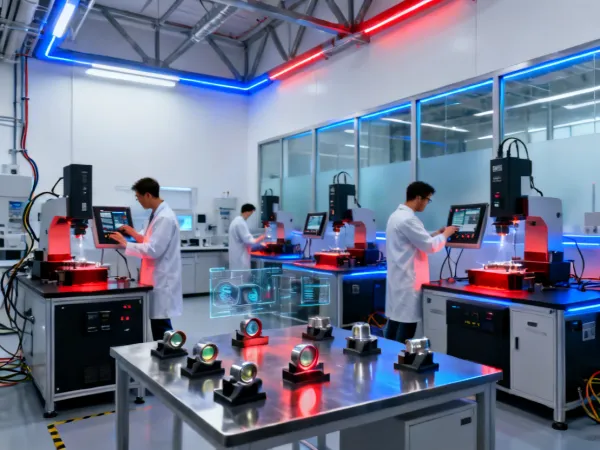
The Thermal Dynamics Innovation Center houses 75 engineers across mechanical design, optical engineering, software development, and applications research. The 26,000 sqm facility includes:
We process over 1,200 sample welding requests per year for customers evaluating laser welding. Every test produces documented results—weld cross-sections, tensile data, and recommended parameters—shared transparently with the customer.
We don't compromise on components. Every critical subsystem comes from established global suppliers with documented performance data.
IPG / Raycus
Fiber laser sources from 200W to 12,000W. IPG for premium-tier systems, Raycus for high-value configurations.
Precitec
German-engineered welding heads with integrated seam tracking and focus position monitoring.
Yaskawa
Servo drives and 6-axis robots with ±0.02mm path repeatability for consistent weld quality.
Beckhoff
EtherCAT-based PLC platforms for real-time process control and MES integration.
If you're working on a welding challenge that conventional technology can't solve, we want to hear about it. Our R&D team collaborates with select partners on pilot projects.